
March 29, 2026
Mini Split vs Window Unit: The Real Comparison
Window units are cheap to buy but expensive to run. Here's how they actually compare to mini splits on efficiency, comfort, noise, and long-term cost.
The Window Unit Problem
Window units are the default solution for garages, workshops, bonus rooms, and older spaces without ductwork. They're cheap to buy at a hardware store, easy to install yourself, and familiar. So why are so many homeowners replacing them with mini splits?
Because cheap upfront doesn't mean cheap to own—and the comfort difference is significant.
Direct Comparison
| Factor | Mini Split | Window Unit | |--------|-----------|-------------| | Upfront cost | $1,500–$3,500 installed | $200–$600 | | Monthly energy cost | Low | 2–3x higher | | Payback period | 2–4 years | Never recovers efficiency cost | | Noise level | 19–30 dB (near silent) | 50–65 dB (very noticeable) | | Heating | Yes (heat pump) | No (cooling only) | | Security risk | None | Open window gap | | Humidity control | Excellent | Moderate | | Air filtration | Multi-stage | Basic | | Appearance | Clean, wall-mounted | Bulky, blocks window | | Lifespan | 15–20 years | 5–10 years |
Energy: The Biggest Difference
This is where window units fall apart for anyone running them regularly.
A typical 12,000 BTU window unit runs at a fixed speed—it's either on at full power or off. Mini splits use inverter technology that continuously modulates output, running at exactly the power needed to maintain the set temperature.
Real-world result: Mini splits use 40–60% less electricity than equivalent window units for the same cooling output.
For a garage or workshop running 4–6 hours per day in a Texas summer, that difference adds up to hundreds of dollars annually. Most homeowners recoup the cost difference within 2–3 years—and then keep saving for the life of the system.
Noise: Not Even Close
Window units are loud. That startup clunk, the constant compressor cycling, the rattle as the unit warms up—it's a familiar but genuinely disruptive sound.
Mini splits operate between 19–30 decibels indoors. Most users describe it as quieter than a ceiling fan. The compressor is outside, and inverter technology means no hard starts or stops.
For anyone using a space to work, sleep, or focus, this is a meaningful quality-of-life difference.
Heating: Window Units Don't
Window units cool only. A mini split is a heat pump—it heats and cools from the same system, typically with greater efficiency than any electric resistance heater.
If you're in Texas and your garage or shop gets cold in January, a window unit offers nothing. A mini split handles both seasons from one installation.
Security
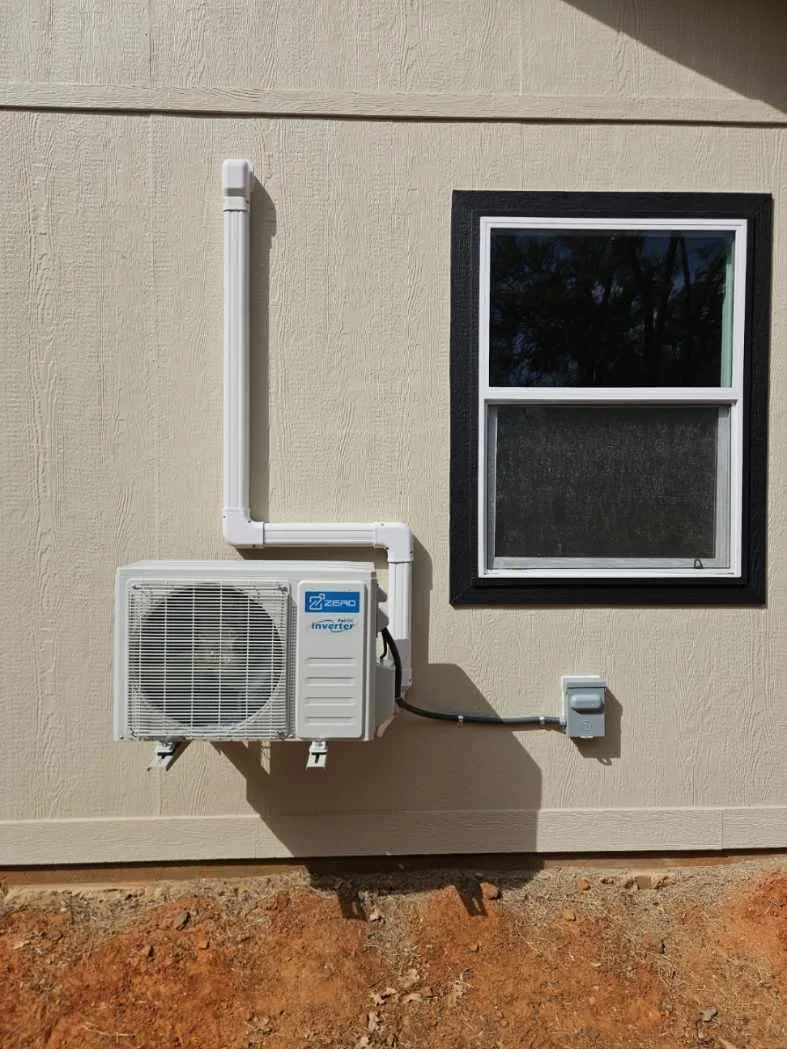
A window unit requires a partially open window—which is a physical gap in your building's security, regardless of how you brace it. Mini splits mount to the wall with a small refrigerant line penetration. No open window. No access point.
Appearance and Property Value
Window units look like what they are—a temporary solution. They block natural light, look bulky in listing photos, and signal that the space wasn't properly finished.
A wall-mounted mini split looks clean and intentional. It photographs well, adds to a space's finished appearance, and signals to buyers that the room is properly climate-controlled.
What About Portable AC Units?
Portable units are even less efficient than window units—they exhaust warm air through a hose, which creates negative pressure that draws in hot outside air through every gap in the building. They're louder, less effective, and cost more to operate. They're a temporary solution at best.
When a Window Unit Still Makes Sense
Window units make sense when:
- You need cooling for a short-term situation (one season, temporary space)
- Budget is extremely limited and long-term running cost isn't a concern
- The space will be demolished or repurposed soon
For any space you plan to use regularly for more than one season, the math almost always favors a mini split.
The Bottom Line
Window units win on purchase price. Mini splits win on everything else—efficiency, comfort, noise, heating capability, appearance, air quality, security, and lifespan.
For Texas homeowners running a garage, shop, bonus room, or converted space through hot summers and occasional cold winters, a mini split pays for itself and keeps paying back. Give us a call if you're ready to stop fighting with a window unit.